
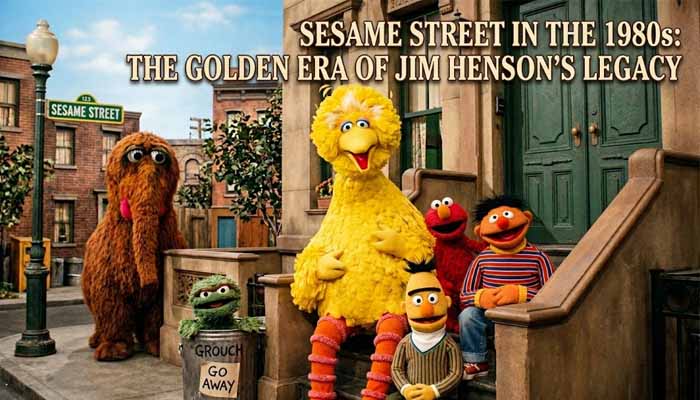

There was nothing quite like the feeling of finishing up a cold neighborhood paper route, shaking off the chill, and switching on the CBC or PBS just in time to hear that iconic harmonica theme song. For many of us, the 1980s was the definitive era of Sesame Street.
While the show broke ground in the late 1960s and 1970s, the 80s was the decade where Sesame Street truly matured. The puppetry was at its absolute peak, the writing took incredible creative risks, and Jim Henson’s genius was firing on all cylinders. Here is a look back at why the 1980s remains the golden era of Sesame Street’s legacy.
When the Street Got Real: The Passing of Mr. Hooper
If there is one moment that defines 80s Sesame Street, it is the 1983 episode addressing the death of Mr. Hooper (played by Will Lee). Instead of recasting the role or saying the character moved away, the producers made the bold decision to explain death to their young audience.
Through the innocent, heartbroken lens of Big Bird, the show delivered a masterclass in empathy. It proved that children’s television didn’t need to talk down to its audience. The raw emotion of the human cast—who were mourning their real-life friend—cemented the show as a deeply authentic program that respected the emotional intelligence of kids.
The Snuffleupagus Reveal
For 14 years, Mr. Snuffleupagus was Big Bird’s “imaginary” friend. The adults on the street always managed to miss him by mere seconds, a running gag that defined the 70s. However, in 1985, the show’s producers noticed a troubling societal trend: children were afraid to report abuse because they believed adults wouldn’t believe them.
To reinforce the message that adults will believe what kids tell them, the writers finally introduced Snuffy to the adults of Sesame Street. It was a brilliant, subtle shift in the show’s lore that prioritized child advocacy over a long-running joke.
Peak Henson and the Golden Age of Felt
The 1980s was an incredibly busy time for Jim Henson. He was juggling The Muppet Show (which wrapped in ’81), Fraggle Rock, Labyrinth, and The Dark Crystal. Yet, his influence on Sesame Street during this time was profound.
The 80s saw the refinement of classic characters and the introduction of new favorites:
- Elmo’s Evolution: Before he became the mega-star of the 90s, the 80s saw the red monster evolve from a nameless background character into the energetic toddler we know today, largely thanks to puppeteer Kevin Clash taking over in 1984.
- Forgetful Jones & The Two-Headed Monster: The physical comedy and absurd humor of these characters brought a distinct, almost vaudevillian flair to the street, showcasing the incredible technical skill of Henson’s core team of puppeteers.
- Musical Masterpieces: From “Put Down the Duckie” to iconic animated segments like the pinball number (“1-2-3-4-5… 6-7-8-9-10… 11-12!”), the musical production value in the 80s was unmatched.
A Legacy That Endures
The 1980s transformed Sesame Street from a groundbreaking educational experiment into an institution. It navigated the delicate balance of being deeply meaningful while remaining incredibly funny. For fans of Muppet history, revisiting the 80s era of Sesame Street isn’t just about nostalgia—it’s a reminder of the unparalleled magic that happens when brilliant artistry meets genuine compassion.