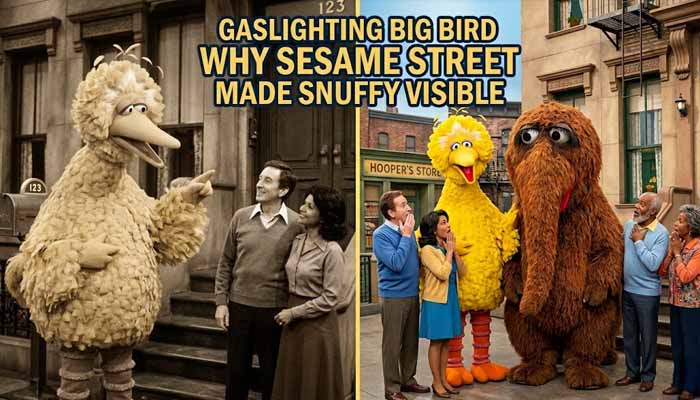
For over a decade, Sesame Street executed one of the longest-running, most elaborate, and highly existential comedic routines in television history. Big Bird had a best friend—a massive, shaggy, four-ton pachyderm-like creature named Aloysius Snuffleupagus. The catch? Whenever the adults of Sesame Street came around, Snuffy miraculously vanished.
From 1971 to 1985, Big Bird was subjected to constant disbelief. To the adults—Bob, Maria, Gordon, and Susan—Mr. Snuffleupagus was merely an imaginary friend. This created a uniquely absurd dynamic: a giant yellow bird trying to prove the existence of a woolly mammoth to a street full of wildly skeptical humans.
But behind the scenes, a major shift in child psychology fundamentally altered the lore of Sesame Street forever. Here is the true story of Snuffy’s evolution.
The Era of the “Near Miss”
During the 1970s, the “imaginary friend” gag was a staple of the show. The writers found endless comedic value in the sheer absurdity of the near-miss. Snuffy would slowly lumber away just seconds before an adult turned the corner, leaving Big Bird holding the bag.
The adults’ reactions were perfectly written to reflect well-meaning but patronizing parents:
- “Sure, Big Bird…” They would humor him, treating Snuffy as a cute coping mechanism.
- The Frustration: Big Bird’s growing exasperation offered a deeply relatable emotional beat for kids, who often feel ignored or misunderstood by the towering adults in their own lives.
It was a brilliant piece of television nonsense. But as the 1980s arrived, the cultural landscape shifted, and the joke started to carry a darker unintended message.
The Psychological Turning Point
By the early 80s, national awareness regarding child psychology and child abuse was rapidly expanding. Experts, psychologists, and educators—many of whom consulted directly for the Children’s Television Workshop (CTW)—began to raise a massive red flag regarding the Snuffleupagus storyline.
The psychological consensus was clear: Children need to know that if they tell an adult the truth, they will be believed.
The experts argued that the dynamic between Big Bird and the adults was unintentionally modeling a dangerous scenario. If children watched Big Bird repeatedly tell the truth about his friend, only to be dismissed, laughed at, or gaslit by the trusted adults in his neighborhood, what would happen if those children needed to report a real-world trauma? Would they stay silent out of fear of not being believed?
The existential comedy had to end. For the safety and psychological well-being of their audience, Snuffy needed to become real to everyone.
Episode 2096: The Big Reveal
The writers spent two years meticulously planning the reveal, which finally aired in Season 17 on November 18, 1985 (Episode 2096).
The setup was classic: Big Bird was desperately trying to get an adult to meet Snuffy. This time, he recruited Elmo to help him hold Snuffy in place by simply yelling “NO!” whenever Snuffy tried to walk away.
When the adults—Bob, Linda, Susan, Gordon, and Maria—finally walked into the area and laid eyes on the colossal Snuffleupagus, the reaction was pure shock. The aftermath of the reveal is a masterclass in restorative television writing:
- The Apology: The adults explicitly apologized to Big Bird. Gordon famously stated, “Big Bird, we owe you an apology. We should have believed you.”
- The Validation: The show made sure to hammer home the new psychological baseline: when you tell us something, we will believe you.
A Legacy Set in Stone
The decision to make Snuffy a visible resident of Sesame Street remains one of the most significant examples of a television show actively listening to real-world behavioral science and adjusting its canon accordingly.
What started as a hilariously absurd running gag transformed into a powerful lesson in trust and validation. Today, Mr. Snuffleupagus stands not just as a beloved piece of Jim Henson history, but as a monument to Sesame Street‘s enduring commitment to its audience.