
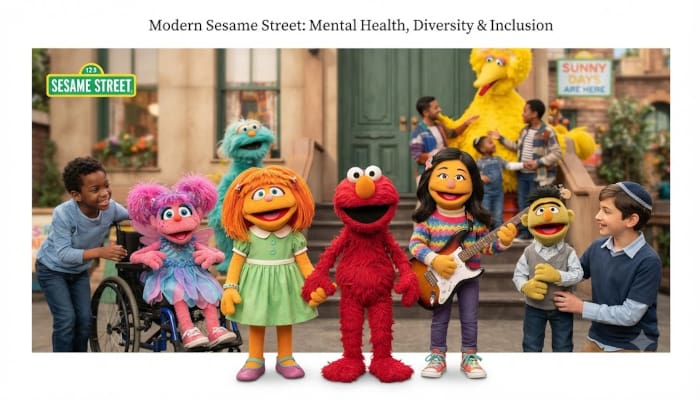

For generations, the famous green door and friendly brownstone stoop of Sesame Street served as a universal classroom. Generations of children learned their ABCs and 123s alongside Big Bird, Bert, and Ernie.
However, the world outside that cul-de-sac has evolved rapidly—and Sesame Street has evolved right along with it. Today, the iconic show is teaching lessons that stretch far beyond the traditional alphabet. Through ground-breaking character additions and intentional storyline updates, Sesame Street is tackling mental health, neurodiversity, racial equity, and complex social issues, helping children navigate a diverse and changing world.
🛠️ The Shift: Why Modern Content Requires More Than Basics
While learning foundational academic skills remains vital, early childhood educators and psychologists emphasize that children also need high emotional intelligence to thrive. Contemporary societal challenges—ranging from systemic inequality to global displacement and family trauma—directly affect young children.
Recognizing this, Sesame Workshop (the non-profit organization behind the show) expanded its curriculum to focus heavily on emotional well-being, empathy, and resilience. The core philosophy is simple: children cannot learn effectively if they do not feel safe, seen, and understood.
🧩 Neurodiversity and Disability: Seeing the “Amazing” in Every Child
One of the most praised modern shifts on the street is the celebration of neurodiversity and physical disabilities. Rather than treating differences as invisible, Sesame Street brings them to the forefront with warmth and honesty.
- Julia: Introduced as part of the See Amazing in All Children initiative, Julia is a vibrant, 4-year-old Muppet who is autistic. Through Julia, children learn that autistic peers may process sensory information differently—such as covering their ears around loud noises—while still loving to play, draw, and make friends.
- Ameera: Featured in international adaptations (like Ahlan Simsim), Ameera is a witty, science-loving girl with a spinal cord injury who uses a wheelchair or crutches. She normalizes physical disabilities while highlighting active play and problem-solving.
By embedding these characters into everyday storylines, the show teaches neurotypical and able-bodied children patience, active inclusion, and empathy early on.
🌍 Representation of Race, Culture, and Family Dynamics
To truly reflect the real world, children need to see families that look like theirs. Sesame Street has systematically introduced characters and resources addressing complex cultural and structural realities:
- The “Coming Together” Initiative: In 2021, the show introduced Wes and his father, Elijah—an African-American father-son duo designed to help families talk openly about race, ethnicity, and even racism.
- Ji-Young: A spirited 7-year-old Korean American Muppet who loves playing the electric guitar, Ji-Young brought visibility to Asian American and Pacific Islander (AAPI) experiences, addressing themes of belonging and standing proud in one’s identity.
- Alternative Family Structures: Characters like Karli (who touched upon the topic of parental addiction and foster care) and Rudy (Abby Cadabby’s stepbrother) validate children experiencing non-traditional home environments, foster care, or housing instability.
🧠 Tackling Big Feelings: Emotional Well-Being Initiatives
Recent seasons—such as We All Have Big Feelings and expanded emotional well-being curricula—focus heavily on mental health tools for preschoolers.
Children are routinely guided through coping strategies for heavy emotions like frustration, grief, sadness, and anxiety. When Elmo, Cookie Monster, or Rosita encounter overwhelming moments, they practice deep breathing, naming their feelings, and asking for help. These tools provide young viewers with a concrete vocabulary for their mental health long before they enter elementary school.
🌟 The Lasting Impact on the Next Generation
Sesame Street proves that educational television can be both timeless and timely. By weaving mental health awareness, racial justice, and inclusion into its comedic fabric, the show ensures that no child feels left out of the neighborhood.
When children see characters who think, look, or live like them—and when their peers learn to celebrate those differences—the result is a kinder, more empathetic generation. After all, the most important lesson Sesame Street continues to teach is that everyone in the neighborhood belongs.