
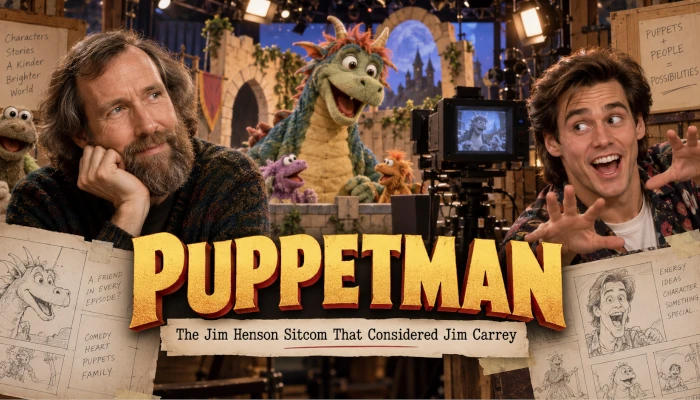

Jim Henson created some of television’s most recognizable characters. But not every idea from the Henson workshop became The Muppet Show, Sesame Street or Fraggle Rock.
One fascinating experiment nearly vanished from television history.
In 1987, Henson produced Puppetman, a half-hour sitcom pilot about the people behind a children’s puppet show. The idea was personal. It took viewers backstage to meet the funny, strange and complicated people who brought the puppets to life.
The project also has a surprising connection to another comedy legend.
Jim Carrey was briefly considered for the lead role.
The future star of Ace Ventura, The Mask and Dumb and Dumber was not cast. However, The Jim Henson Company Archives confirm that Henson’s team discussed Carrey during the casting process.
If Carrey had landed the part, Puppetman might have become one of his earliest major starring roles.
Jim Henson’s Idea for Puppetman
The idea for Puppetman came from a world Jim Henson knew well: television puppetry.
Viewers of Sesame Street and The Muppet Show saw the finished illusion. Puppets seemed alive. They spoke with celebrities and acted like characters separate from the performers who controlled them.
Behind the scenes, a large team made that illusion possible. Puppeteers, writers, directors, designers and technicians worked together, often from cramped or unusual positions.
Henson saw a sitcom in that backstage world.
According to The Jim Henson Company Archives, he developed the first version of Puppetman in the summer of 1986. The story followed a young puppeteer working on a local television show in Providence, Rhode Island.
The idea echoed Henson’s own early career.
Before he became famous, Henson worked in local television. His early credits included the Washington, D.C. program Sam and Friends. A comedy about a young television puppeteer therefore had a clear autobiographical connection.
The show would not focus only on puppets. Its stories would explore:
- Conflicts between performers and television executives
- Competition for airtime
- Backstage arguments
- Celebrity guests
- The difference between puppeteers and the characters they played
In other words, Puppetman was not meant to be a children’s show.
It was a sitcom about the people who made one.
Puppetman Becomes Dragontime
As development continued, the concept changed.
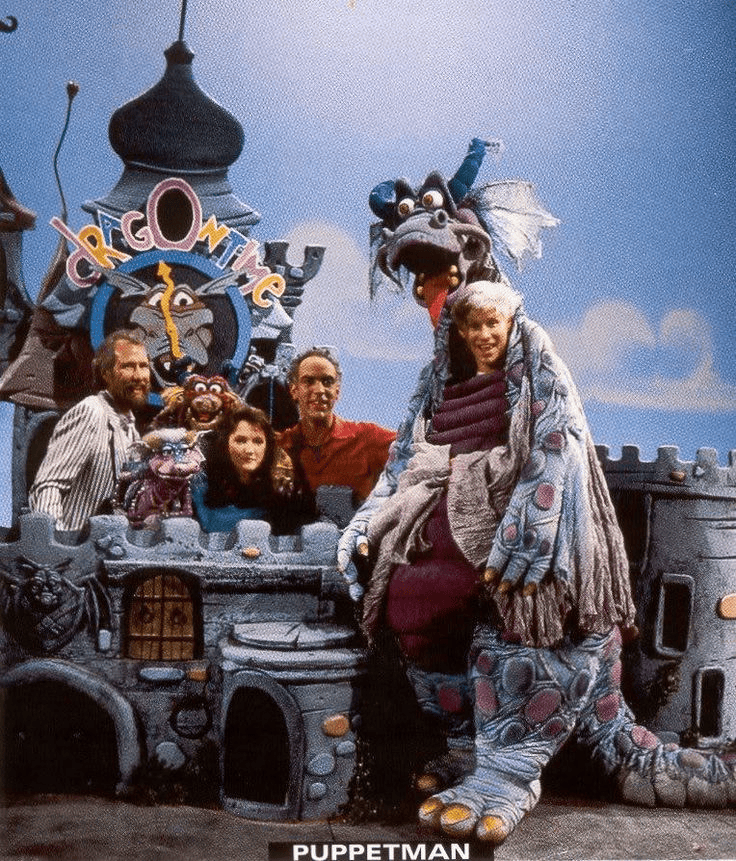
The pilot centered on Gary, a puppeteer and single father. He worked on a children’s television program called Dragontime in Madison, Wisconsin.
The fictional show featured a large dragon named Butane, performed by Gary.
This setup gave Puppetman two worlds to explore. Viewers could see the colorful children’s show on camera. They could also see the personal problems unfolding behind it.
Gary’s family life was central to the story. He struggled to balance his job with his duties as a father, especially his relationship with his young son, Zack.
The result was a mix of family sitcom, workplace comedy and backstage puppetry. That combination was unusual for network television in 1987.
CBS Became Interested
Jim Henson’s longtime agent, Bernie Brillstein, helped pitch the idea. CBS then purchased the pilot.
Writers Mark Reisman and Jeremy Stevens joined the project to develop the script.
Henson wanted them to understand the world they were writing about. The writers studied television puppetry and learned how unusual the work could be.
Henson staff member Bill Prady helped with their research. Prady later became one of the co-creators of The Big Bang Theory.
Henson performers Kevin Clash and Steve Whitmire also contributed material. They shared their experiences as young television performers.
The project was more than a quick experiment.
Henson was creating a complete fictional television production.
Jim Carrey Was Considered for Puppetman
Then came the casting process.
This is where Puppetman becomes even more interesting.
The Jim Henson Company Archives note that Henson’s team briefly discussed Jim Carrey for the role of Gary.
That detail should not be overstated.
The archives do not suggest that Carrey accepted the role. They also do not indicate that a deal was close to completion.
His name was simply part of the conversation.
Still, the possibility creates an intriguing television “what if.” Only a few years later, Carrey would become one of the biggest comedy stars in the world.
Imagine an alternate late 1980s in which Jim Carrey starred in a Jim Henson sitcom about a television puppeteer.
Would Puppetman have become a series?
Would Carrey have found fame sooner?
Could he have worked with the Henson organization again?
We will never know.
Fred Newman Became Henson’s Puppetman
Instead, Jim Henson cast Fred Newman.
Newman already had ties to Henson. He had contributed to Muppet Magazine and worked on the Muppets’ live arena productions.
Henson knew Newman well enough to see him as the right person to play Gary.
The Jim Henson Company has described Gary as a surrogate for Jim Henson himself.
Newman later described the role in similar terms. He recalled playing a young version of Henson in the CBS pilot.
That connection makes Puppetman especially interesting for Henson fans.
Gary was not Jim Henson in a literal sense. But the character may offer a glimpse into how Henson viewed the unusual profession he had spent decades helping to reshape.
Richard Hunt Joined the Cast
Another familiar Henson performer appeared in the pilot.
Richard Hunt played Del, another puppeteer.
Hunt was one of the most important Muppet performers of his generation. He performed characters such as Scooter, Janice, Beaker and Statler.
Seeing him outside the puppets themselves adds another layer of interest to the pilot.
Veteran comedy writer and performer Jack Burns played Bud Stone, the television director. Burns also had strong Henson connections. He wrote for both The Muppet Show and The Muppet Movie.
The cast combined traditional television actors with performers who understood puppetry firsthand.
Even Ron Mueck Helped Create Puppetman
The project also attracted major creative talent behind the scenes.
Ron Mueck created character designs for Puppetman.
Mueck is now known for his highly realistic sculptures. Many of them depict human figures at unusual sizes.
Before he became famous in the art world, Mueck worked extensively with Jim Henson.
For Puppetman, he helped design the dragons used on the fictional Dragontime. Henson’s archives still preserve some of those designs, along with storyboards Jim created for the pilot.
The project shows how much creative talent passed through Henson’s workshop.
Puppetman Finally Airs in 1987
After years of development, Puppetman reached television.
The pilot aired on July 3, 1987, as part of CBS Summer Playhouse. The anthology series gave networks a place to show pilots that had not received full-season orders.
The broadcast did not lead to a series.
The Henson archives describe the response as lukewarm. CBS decided not to order more episodes.
One pilot was all audiences received.
Unlike Kermit, Fraggle Rock or The Storyteller, Puppetman slowly became a footnote in Jim Henson’s career.
Could Puppetman Have Worked?
Looking back, the show’s failure is surprising.
Modern audiences are comfortable with workplace comedies about entertainment, news and television production. Puppetman used a similar idea, but with an unusual twist.
Its characters worked in a world where pieces of foam, fabric and fur had to appear alive.
That premise offered many possibilities.
A celebrity could act one way on camera and another backstage.
Two puppeteers could dislike each other while their characters played best friends.
A silly puppet story could reflect a serious problem in a performer’s life.
The show could also reveal puppetry techniques without ruining the magic. Learning how the illusion worked could have been part of the fun.
The writers had an entire world to explore.
Sadly, viewers never learned where that world might lead.
The Jim Henson Sitcom We Almost Got
Puppetman will probably never rank among Jim Henson’s greatest achievements.
That is exactly why it deserves another look.
The pilot shows Henson experimenting with a new format. Even after creating the Muppets, helping transform Sesame Street, launching Fraggle Rock and producing films such as The Dark Crystal and Labyrinth, he continued to search for new uses for puppetry.
Puppetman was not another Muppet variety show.
It was not a fantasy film.
It was not traditional children’s television.
It was a workplace and family sitcom set inside the world of professional puppetry.
During the creation of that forgotten 1987 pilot, Henson’s team also considered a performer who was still waiting for his major breakthrough.
Jim Carrey.
Sometimes failed projects leave behind the most fascinating stories.
And Puppetman leaves Henson fans with one irresistible question:
What would a Jim Henson sitcom starring Jim Carrey have looked like?