
When you picture Cookie Monster and Grover, you instantly think of bright blue fleece, friendly faces, and the legendary voice of Frank Oz. But any true Sesame Street fan knows that Jim Henson’s characters rarely started out fully formed. The Muppets we know and love went through years of tweaking, rebuilding, and character development before they found their permanent homes at 123 Sesame Street.
For the hardcore historians at MuppetMadness, let’s take a deep dive into the physical and performance evolution of two of the street’s most iconic monsters.
Cookie Monster: From Explosive Vandal to Cuddly Glutton
It’s hard to imagine a world where Cookie Monster isn’t a lovable, cookie-obsessed goofball. But his origins are surprisingly dark—and toothy.
The Wheel-Stealer and the IBM Days
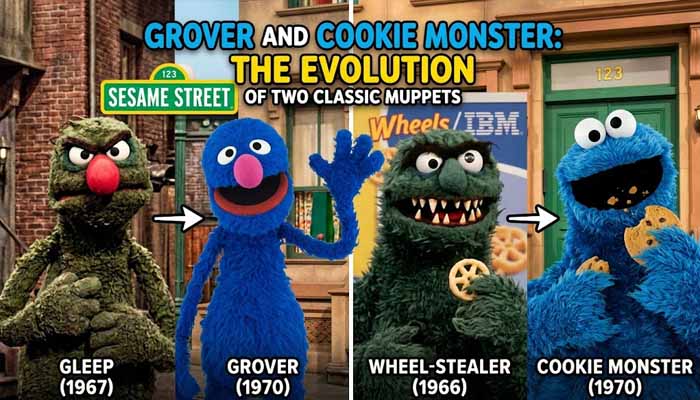
Cookie Monster’s earliest prototype was built in 1966 for an unaired General Foods commercial selling snacks called Wheels, Crowns, and Flutes. Jim Henson designed a ravenous, green-ish monster known as the “Wheel-Stealer.” This early puppet had wonky eyes, sharp, pointed fangs, and a much more sinister look.
In 1967, Henson reused this fanged puppet for an IBM training film called Coffee Break Machine. In the sketch, the monster devours a complex coffee machine piece by piece. When he finishes, the machine announces that its anti-vandalism system has been triggered, and the monster promptly explodes.
Frito-Lay and the Blue Fur Makeover
Before arriving on Sesame Street, the monster went through one more commercial phase in 1969. He was remade with purple-ish/blue fur as “Arnold the Munching Monster” for a series of Frito-Lay Munchos commercials.
When Sesame Street launched later that year, Henson removed the sharp teeth to make him more child-friendly. He debuted in the first season as an unnamed, ravenous monster. It wasn’t until the second season that his character solidified, his fur became the iconic vibrant blue, and he officially claimed the name “Cookie Monster.”
Grover: The Greenish-Brown Years of Gleep
Much like his cookie-eating counterpart, Grover’s journey to becoming a “cute, furry, little monster” was a bumpy one.
A Grumpy Start on Ed Sullivan
Grover actually predates Sesame Street. A prototype version of the puppet made his debut on The Ed Sullivan Show on Christmas Eve in 1967. But he wasn’t blue, and he certainly wasn’t cute.
Referred to in the sketch as “Gleep,” this early monster had:
- Murky, greenish-brown fur.
- A bulbous red nose.
- Malignantly-angled eyes that made him look angry.
- A raspy, abrasive voice performed by Frank Oz.
This “Proto-Grover” (sometimes affectionately called “Fuzzyface” by fans) actually appeared in the first season of Sesame Street. He was often used in background sketches and was noticeably grumpier and less helpful than the Grover we know today.
Finding the Blue and the Heart
The turning point happened in May 1970 during another appearance on The Ed Sullivan Show. The puppet had been rebuilt with his now-signature cobalt blue fur, a pink nose, and softer, friendlier eyes.
This updated design was brought over to Season 2 of Sesame Street, where Frank Oz softened his voice and infused the character with the endearing, desperate-to-help anxiety that made Grover a superstar.
Passing the Fleece: The Performers Behind the Monsters
You can’t talk about the physical evolution of a Muppet without talking about the literal hands that brought them to life. The true magic of Grover and Cookie Monster originated with Frank Oz. Oz didn’t just provide the voices; his physical puppetry style—Grover’s frantic arm flailing and Cookie Monster’s aggressive, crumb-scattering chewing—defined the characters.
As Frank Oz transitioned into directing films, he needed to pass the torch to a new generation of performers to keep the characters alive on the street.
- Eric Jacobson (Grover): Jacobson began taking on Grover’s duties in 1998, officially becoming his primary performer in 2002. Jacobson meticulously studied Oz’s cadence and physical timing, ensuring that Super Grover’s crash-landings felt just as chaotic and hilarious as they did in the 1970s.
- David Rudman (Cookie Monster): Rudman took over Cookie Monster in 2001. He perfectly captured the guttural sounds and the specific, erratic eye-rolls that make Cookie Monster’s voracious appetite so universally funny.
Both Jacobson and Rudman have managed the impossible: honoring the foundational legacy of Frank Oz while continuing to evolve these beloved monsters for a modern audience.