
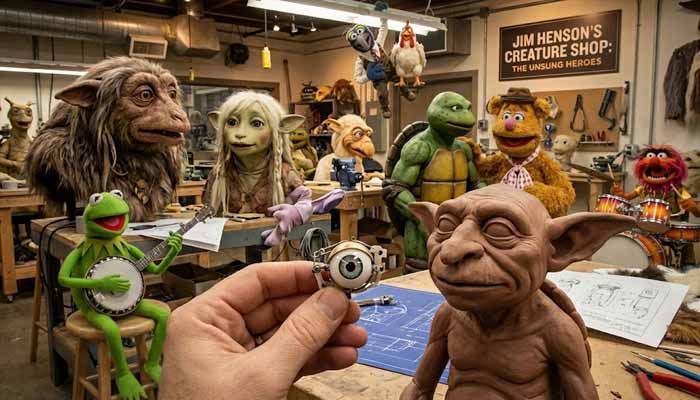

When most people hear the name “Jim Henson,” they instantly picture Kermit the Frog or Big Bird. But beyond the felt and fur of The Muppets lies a grittier, more complex legacy: Jim Henson’s Creature Shop.
For over four decades, this powerhouse of practical effects has been the invisible force behind some of cinema’s most enduring monsters, aliens, and fantasy icons. From the Skeksis in The Dark Crystal to the animatronic marvels of the 1990 Teenage Mutant Ninja Turtles, the Creature Shop has consistently blurred the line between puppet and living being.
This article pulls back the curtain on the “unsung heroes” of the Creature Shop—the sculptors, engineers, and digital puppeteers who breathe life into the inanimate.
From Muppets to Monsters: The Origin Story
The Creature Shop was born out of necessity. In 1979, Jim Henson wanted to move beyond the abstract comedy of the Muppets to create a “realistic” fantasy world for The Dark Crystal (1982). He needed creatures that didn’t just look like puppets; they needed to look like biological organisms.
Henson assembled a team of British illustrators (including Brian Froud), fabricators, and mechanics in London. They developed groundbreaking techniques, including:
- Foam Latex Skins: Allowing for realistic wrinkles and breathing.
- Radio-Controlled Mechanisms: Enabling remote operation of eyes and facial expressions, separating the puppeteer from the physical puppet.
This marked the shift from “Muppet” to “Creature,” setting the stage for the cult classic Labyrinth (1986) and its iconic Goblin King minions.
The Golden Age of Animatronics
In the early 1990s, the Creature Shop achieved what many still consider the pinnacle of suit performance: the Teenage Mutant Ninja Turtles movie.
While CGI was in its infancy, the Shop built full-body animatronic suits that allowed stunt performers to fight while puppeteers off-camera controlled the facial expressions via the Henson Performance Control System. This technology allowed for:
- Lip-syncing in real-time.
- Nuanced emotions (grimaces, smiles, eye-widening).
- High-impact stunts without damaging the delicate mechanics inside the heads.
This era also gave us the sitcom Dinosaurs, proving that animatronics could sustain a weekly primetime TV show with complex dialogue and comedy.
The Digital Revolution: The Henson Digital Puppetry Studio
One of the Shop’s greatest “unsung” achievements is how they revolutionized CGI. As the industry pivoted to digital effects, the Creature Shop didn’t abandon puppetry; they digitized it.
The Henson Digital Puppetry Studio (HDPS) allows puppeteers to perform computer-generated characters in real-time. Instead of animators key-framing every movement frame-by-frame, a puppeteer uses a joystick and digital glove to control a CGI character on a screen instantly.
Why this matters for SEO and Film History:
- Spontaneity: It keeps the improvisational soul of the Muppets alive in digital animation (seen in Sid the Science Kid).
- Speed: It drastically reduces production time for animation.
- The Human Touch: It ensures that even digital characters have the “heart” of a human performance.
The Modern Renaissance: Five Nights at Freddy’s and Beyond
In recent years, there has been a massive resurgence in the demand for practical effects, and the Creature Shop is once again at the forefront.
Audiences are tired of weightless CGI. They crave the tactile reality of physical props. The Creature Shop’s work on the Five Nights at Freddy’s (FNAF) movie brought the terrifying animatronics of the video game into the real world, proving that practical effects can still drive box office success in the 2020s.
Furthermore, the critically acclaimed The Dark Crystal: Age of Resistance (Netflix) showcased a hybrid approach—using classic puppetry enhanced by subtle CGI—demonstrating that the old ways, when polished with new tech, are timeless.
Meet the Unsung Heroes
Who are the people actually building these dreams? The Creature Shop is a hive of diverse talents:
- The Wranglers: The on-set technicians who rush in between takes to fix a broken servo or patch a tear in a foam skin.
- The Fabricators: Artists who spend hours punching individual hairs into silicone heads to create realistic fur lines.
- The Mechatronics Engineers: The inventors who figure out how to fit 30 motors into a skull the size of a grapefruit.
Key figures like Peter Brooke (Creative Supervisor) and Brian Henson (Chairman) continue to drive the shop’s innovation, ensuring that Jim’s original vision of “making the impossible real” endures.
Conclusion
Jim Henson’s Creature Shop is more than just a special effects house; it is a guardian of an endangered art form. In a world dominated by green screens, they remain the masters of the tangible, reminding us that there is no substitute for a creature you can actually reach out and touch. They are the unsung heroes who make us believe, if only for a moment, that magic is real.