
The Strange Origin of Mahna Mahna: From an Adult Film to Muppet History
It’s one of the most recognizable songs in Muppet history. But the story of where “Mahna Mahna” actually came from is far stranger than you might expect.
There are certain sounds that instantly transport you back to childhood. Kermit’s voice, the opening notes of The Muppet Show theme, and, of course, that ridiculously catchy nonsense song:
Mahna Mahna!
You probably supplied the next part in your head without even thinking about it.
For generations of Muppet fans, “Mahna Mahna” has been pure Jim Henson magic: a wild-haired creature, two peculiar pink backup singers, and a musical performance that somehow manages to be both completely ridiculous and absolutely brilliant.
But here’s something that might surprise you.
“Mahna Mahna” wasn’t written for the Muppets. It wasn’t even written for children’s television.
Its origins lead back to a rather unusual Italian film from 1968, a composer experimenting with jazz and film music, and a soundtrack associated with a very adult subject.
Somehow, that unlikely beginning led to one of the most beloved musical performances in television history.
And the journey is almost as bizarre as the song itself.
The Original Mahna Mahna Came from a 1968 Italian Film
Before Jim Henson’s colorful creatures ever performed the tune, “Mahna Mahna” was a composition by Italian musician Piero Umiliani.
Umiliani was an accomplished jazz musician and film composer who worked extensively in Italian cinema during the 1950s, 1960s, and 1970s.
In 1968, he composed music for a film called Svezia, inferno e paradiso, released internationally as Sweden: Heaven and Hell.
And this certainly wasn’t a children’s movie.
Directed by Luigi Scattini, the film was a sensationalized documentary examining Swedish society, sexuality, nightlife, and social customs. It belonged to a filmmaking genre commonly called mondo, known for presenting supposedly shocking aspects of cultures around the world.
Among the music associated with the production was a peculiar, playful instrumental-and-vocal number originally titled “Viva la Sauna Svedese,” meaning “Long Live the Swedish Sauna.”
Yes, the song that would become inseparable from adorable felt creatures and children’s laughter had its roots in an adult-oriented Italian documentary about Sweden.
Try explaining that one to Kermit.
Was Mahna Mahna Actually Played During a Sauna Scene?
Many retellings of the story describe the tune accompanying a Swedish sauna sequence.
The connection is certainly understandable, especially considering the original title.
However, there’s an interesting historical wrinkle.
Music historian Maurizio Corbella, writing in the 2025 academic book Anonymous Sounds, describes the composition as an outtake from Umiliani’s soundtrack project.
He documents its appearance on Umiliani’s 1968 production-music compilation Psichedelica.
That makes the precise account of how the music was used in the finished film less straightforward than the popular story suggests.
What is well established is its connection to the 1968 soundtrack project and its decidedly unexpected origins.
Either way, it wasn’t exactly the sort of musical background anyone would have predicted becoming a classic Muppet routine.
Who Originally Sang Mahna Mahna?
The original recording featured the distinctive vocal talents of Italian musician Alessandro Alessandroni, whose playful singing helped give the tune its unmistakable personality.
Alessandroni was an accomplished musician known for his whistling, guitar playing, and vocal contributions to Italian film scores.
The composition combined an infectious rhythm, jazz-inspired improvisation, and nonsense syllables rather than traditional lyrics.
That last detail is important.
Unlike most songs, “Mahna Mahna” doesn’t rely on a story or meaningful words. Its personality comes almost entirely from its sounds, musical timing, and playful repetition.
It was practically begging for somebody with an imagination as unusual as Jim Henson’s to discover it.
How Did Mahna Mahna Reach American Television?
The song didn’t travel directly from an Italian movie studio into the hands of the Muppets.
It had another life first.
Umiliani’s music was distributed internationally, and the track was released in the United States under the now-familiar title “Mah Nà Mah Nà.”
In 1969, the recording received American radio airplay and even made it onto the Billboard Hot 100, reaching No. 55.
For a song consisting largely of nonsense syllables, that was quite an achievement.
The tune was also used by The Red Skelton Show, demonstrating that American television entertainers had already recognized its comedic possibilities.
But its most important transformation was still to come.
That would happen when Jim Henson brought his particular brand of musical absurdity to the composition.
Jim Henson Brings Mahna Mahna to Sesame Street in 1969
Contrary to what some viewers remember, the famous The Muppet Show performance wasn’t the first time Henson’s puppets performed “Mahna Mahna.”
That distinction belongs to Sesame Street.
On November 27, 1969, the fourteenth episode of the groundbreaking children’s series featured an early Muppet performance of the song.
But it looked different from the version most people know today.
The early routine used different puppets, including a scruffy, bearded lead character and two female Anything Muppets.
The familiar pink Snowths weren’t part of that original Sesame Street arrangement.
According to the Jim Henson Company Archives, Henson adapted some of his existing variety-show material for Sesame Street while maintaining separate puppet designs for commercial and educational television appearances.
Even the backing vocals differed between the versions.
The essential comic idea, however, was already there: an enthusiastic performer trying to break free of a repetitive musical pattern while his companions attempted to keep everything on track.
It was the perfect setup for the glorious nonsense that followed.
The Ed Sullivan Show Introduced the Famous Mahna Mahna and Snowths
Just three days after the Sesame Street episode aired, on November 30, 1969, Henson performed “Mahna Mahna” on The Ed Sullivan Show.
This time, audiences met the characters who would become permanently associated with the song.
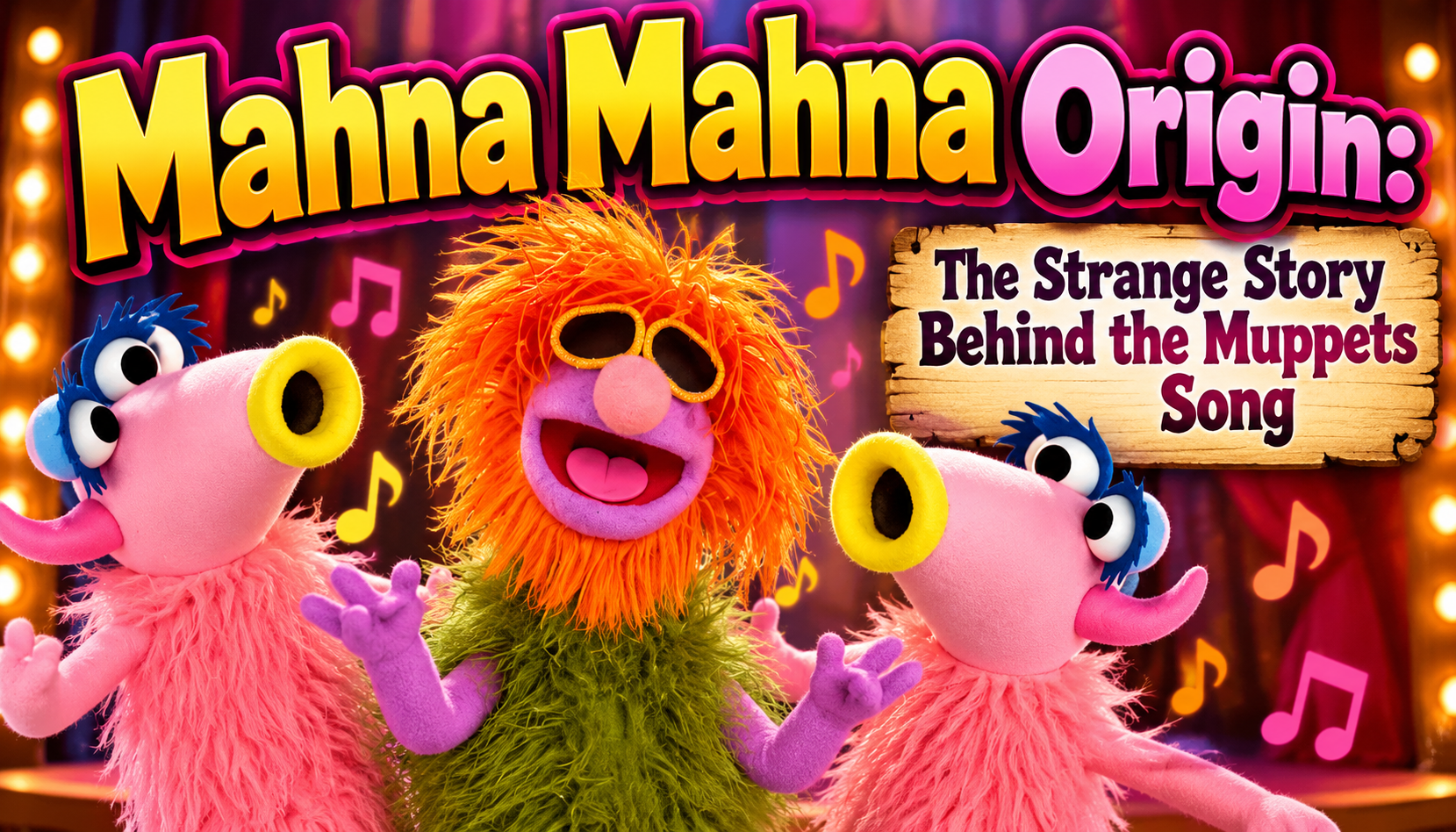
There was Mahna Mahna himself, a purple-faced, orange-haired creature sporting a furry green tunic and a truly magnificent amount of facial hair.
Alongside him were two matching pink creatures with unusual horn-like features and enormous mouths.
These were the Snowths, originally also referred to as Snouths.
And together, they created comedy gold.
Jim Henson designed the puppets, while Don Sahlin and Caroly Wilcox helped bring the designs to life.
What made the performance memorable wasn’t simply the music.
It was the characters’ personalities.
The Snowths wanted to maintain their predictable musical refrain. Mahna Mahna, on the other hand, couldn’t seem to resist wandering off into his own increasingly elaborate improvisations.
Every time the routine appeared ready to settle down, he found another opportunity to disrupt it.
It was a tiny musical rebellion performed by three pieces of felt.
And somehow, it was brilliant.
The Muppet Show Turned Mahna Mahna into a Classic
Although the song had already appeared on television, its most celebrated Muppet performance arrived in 1976.
In the first episode of The Muppet Show, featuring guest star Juliet Prowse, Mahna Mahna and the Snowths performed a new version of their increasingly chaotic musical number.
And this was where the routine truly became unforgettable.
Mahna Mahna simply couldn’t stick to the arrangement.
The Snowths tried to rein him in, but he was too busy enjoying himself.
At one point, he even wandered away from the stage and out of the Muppet Theatre.
Surely that was the end of the song.
Of course not.
A telephone rang backstage. Kermit answered and brought the receiver out to the Snowths.
And from the other end came one last unmistakable contribution from Mahna Mahna.
It was a perfect example of Henson’s comedic instincts: a simple joke taken one ridiculous step further than anybody expected.
The song was now much more than an Italian novelty recording.
It was a piece of Muppet history.
Why Is Mahna Mahna So Unforgettable?
Think about what actually happens during the performance.
Three unusual creatures sing a song that doesn’t really mean anything.
That’s it.
There is no elaborate storyline. No complicated set. No sophisticated dialogue.
Yet more than half a century later, people still recognize the tune almost immediately.
Why?
Part of the answer lies in the musical arrangement. The repetitive melody is extremely easy to remember, while the improvised vocal passages make the performance feel spontaneous.
But the real magic is in the puppetry.
Jim Henson understood that even the simplest characters could become hilarious when given recognizable personalities.
Mahna Mahna is the uncontrollable free spirit.
The Snowths are the increasingly exasperated voices of order.
And the audience gets to enjoy watching one determined troublemaker repeatedly undermine the entire performance.
In many ways, that contrast sums up the Muppets themselves.
They’re at their funniest when somebody desperately wants everything to go according to plan, and somebody else makes that completely impossible.
Usually, Kermit is the poor soul trying to maintain order.
In this case, the Snowths got the job.
Mahna Mahna Became Bigger Than the Muppets
The tune’s television history extends beyond Jim Henson’s productions.
It was associated with The Red Skelton Show and later became familiar through the comedy of The Benny Hill Show.
Its catchy melody has continued to appear in popular culture through recordings, television performances, and musical tributes.
The Muppets themselves returned to the song numerous times over the decades, including during the promotion and release of the 2011 film The Muppets.
But no matter how many times the tune resurfaces, its association with Henson’s strange little trio remains especially powerful.
For many people, the melody immediately brings to mind an orange-haired puppet throwing himself enthusiastically into the performance while two pink creatures look increasingly unimpressed.
It’s difficult to imagine a better legacy for a song made almost entirely from nonsense.
So What Does Mahna Mahna Actually Mean?
Here’s another little mystery.
Despite its worldwide recognition, “Mahna Mahna” doesn’t have a conventional lyrical meaning.
The phrase functions as a nonsense vocal hook rather than a statement with a hidden translation.
The original title, “Viva la Sauna Svedese,” had an identifiable meaning, but the musical syllables themselves weren’t telling a story.
And perhaps that’s part of the appeal.
You don’t need to understand Italian, English, or any other language to appreciate the routine.
You only need a sense of humor and a willingness to embrace a little silliness.
Jim Henson understood that better than almost anyone.
A Strange Little Song with an Extraordinary Legacy
When Piero Umiliani created music for an unusual Italian documentary in 1968, it’s hard to imagine anyone predicting what would happen next.
Within a few years, one of his compositions would travel from the world of adult-oriented Italian cinema to American radio, children’s television, and eventually one of the most famous puppet variety shows ever created.
The melody would be remembered by generations of viewers who had never heard of its original composer or the film that inspired it.
And the characters performing it would become beloved pieces of Jim Henson history.
That’s what makes the strange origin of “Mahna Mahna” such a wonderful story.
It demonstrates how creativity can transform something completely unexpected into something entirely new.
Henson didn’t need to invent the melody to make the performance his own.
He simply recognized the comic possibilities, added unforgettable characters, and let a little controlled chaos take over.
More than five decades later, the result still makes people smile.
Not bad for a song with absolutely nothing to say.
Now It’s Your Turn, Muppet Fans!
Do you remember the first time you heard “Mahna Mahna”?
Was it on Sesame Street, The Ed Sullivan Show, The Muppet Show, or somewhere completely different?
And did you already know about its strange origins in Italian cinema?
Tell us in the comments!
For more forgotten Muppet history, character deep dives, trivia, and gloriously ridiculous fun, visit MuppetMadness.com. Join our community, share your favorite memories, and keep the madness alive!