
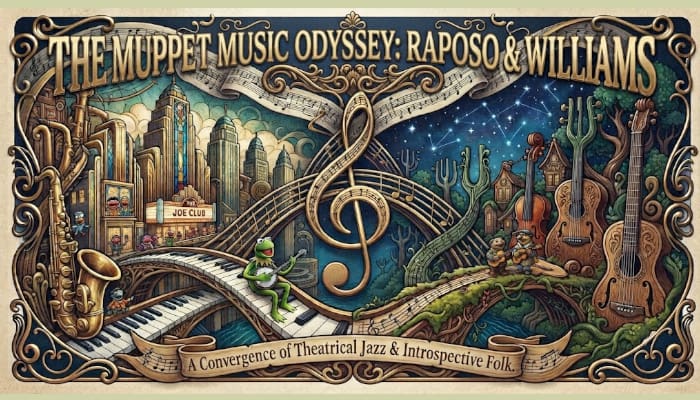

When we think of the Jim Henson universe, our minds instantly drift to the visual landmarks: the precise, snappy snap-jaw movement of a classic frog, the intricate folds of a Skeksis costume, or the cozy, chaotic clutter of a boarding house on Sesame Street.
Yet, the true architectural genius of Henson’s empire was never purely visual. It was sonic.
Music in the Henson universe was never a mere background accessory or an easy way to pad out a runtime. It was the emotional load-bearing wall. It held up entire worlds, bridged the gap between cynical adults and wide-eyed children, and gave felt and foam a beating, vulnerable human heart.
To understand how Henson achieved this alchemy, we have to look at the master architects who built its soundscape: Joe Raposo and Paul Williams. By contrasting Raposo’s jazzy, theatrical optimism with Williams’ melancholic, introspective pop songcraft, we uncover how these composers weaponized earnestness without ever slipping into cheese—turning simple human longings into timeless anthems.
Joe Raposo: The Architect of Theatrical Optimism
If the Jim Henson sonic universe has a beating pulse, Joe Raposo provided its steady, life-affirming rhythm. As the primary musical force behind early Sesame Street and specials like The Muppet Musicians of Bremen, Raposo possessed a rare gift: he could write a melody that felt instantly classic, like a standard pulled straight from the Great American Songbook, yet accessible enough for a five-year-old to hum.
The Jazz-Infused Sound of Hope
Raposo’s background in jazz and theater heavily influenced his compositions. He didn’t write “kid music.” He wrote sophisticated arrangements featuring walking basslines, bouncing brass, swinging piano chords, and unexpected time signatures.
- “Bein’ Green”: Perhaps Raposo’s masterpiece. Instead of an over-the-top, sugary children’s ditty, Kermit’s signature ballad is a gentle, bluesy, melancholic shuffle. It validates feelings of inadequacy and being an outsider, wrapped in a lush, theatrical arrangement that treats the listener’s emotions with profound respect.
- “Sing”: A masterclass in communal joy. Raposo structures the song to build iteratively, starting small and intimate before swelling into a massive, inclusive chorus. It captures a distinctly urban, theatrical optimism—the idea that despite the concrete and chaos of the world, we can harmonize if we just try.
Raposo’s genius lay in his belief that children—and puppets—deserved rich, complex musical arrangements. He treated his audience with dignity, proving that optimism doesn’t have to be naive; it can be an active, courageous choice.
Paul Williams: The Poet of Introspective Pop and Melancholy Longing
While Raposo built the bright, communal town square, Paul Williams walked out to the edge of the woods, looked up at the stars, and wrote about yearning. Brought onto projects like The Muppet Movie and Emmet Otter’s Jug-Band Christmas, Williams injected a bittersweet, introspective pop sensibility into the Henson canon.
The Pop Craft of Vulnerability
As a legendary pop songwriter who penned hits for mainstream icons like The Carpenters and David Bowie, Williams brought a distinct singer-songwriter vulnerability to the Muppets. His arrangements favored acoustic guitars, soaring string sections, and gentle, confessional vocal deliveries.
- “Rainbow Connection”: Co-written with Kenneth Ascher, this song is a structural marvel. It begins with a lone banjo and a slightly unsure frog, slowly blooming into a sweeping, cinematic ballad about the eternal human search for meaning. It captures the ache of ambition paired with the comfort of simple companionship.
- “Whenever I Call You Friend” vibes / “Just One Person”: Williams understood that the Muppets work best when their existential struggles mirror our own. His songs are frequently about looking for your place in the world, missing someone who is far away, or holding onto hope against steep odds.
Williams didn’t shy away from sadness. He infused his Muppet tracks with a cozy melancholy, teaching generations that longing and joy are often two sides of the exact same coin.
Weaponizing Earnestness: Why These Anthems Stand the Test of Time
In modern media, earnestness is often treated like a hazard. Creators hide behind layers of irony, winking at the camera to ensure they never look “uncool” or overly sentimental.
Henson, Raposo, and Williams did the exact opposite. They doubled down on radical sincerity.
- Zero Cynicism: When a frog sings about looking for rainbows, or a monster sings about how hard it is to be the color of grass, there is zero irony. The emotional stakes are treated with complete, unyielding gravity.
- Universal Longing: Raposo’s theatrical swing and Williams’ pop introspection tap into fundamental human desires: the desire to belong, the desire to create, the desire to be understood, and the desire to find joy in a complicated world.
- The Contrast of Form: The brilliance of these musical arrangements is amplified by the medium itself. Hearing a piece of deeply profound, heartbreakingly earnest music come out of a puppet made of fleece and ping-pong balls strips away our emotional armor. We drop our guard because it’s “just a puppet,” only to realize the song has pierced straight to our core.
The Lasting Echo of Henson’s Sonic Legacy
The acoustic architecture built by Joe Raposo and Paul Williams proved that music could transcend the screen. Their songs are not just remembered as nostalgic TV tunes; they are performed by modern indie bands, sung at weddings, and used as personal anthems for navigating adulthood.
Next time you hear the opening notes of a classic Henson ballad, listen past the nostalgia. Notice the jazz chords, the sweeping strings, and the fearless emotional weight. You aren’t just hearing a song for children—you’re listening to two musical titans turning simple human longing into acoustic gold.
Thanks for exploring the sonic architecture of the Muppet universe with us! If you love diving into forgotten Muppet media, classic soundtracks, and behind-the-scenes pop culture history as much as I do, be sure to check out our other posts here on muppetmadness.com for more deep dives into the Jim Henson archives.