
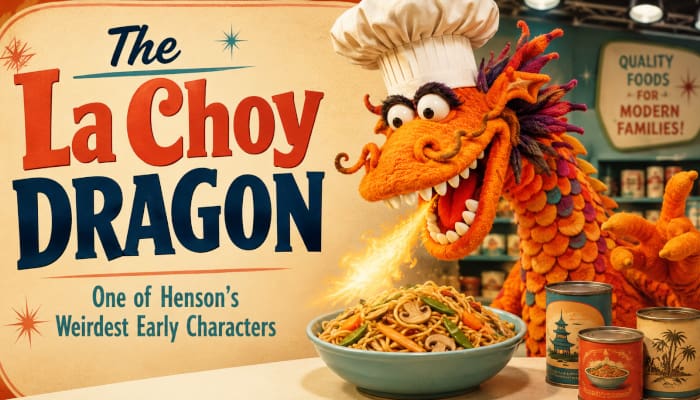
Long before The Muppet Show, Sesame Street or Fraggle Rock, Jim Henson created a giant orange dragon whose job was to sell chow mein—and breathe real fire while doing it.
His name was Delbert the La Choy Dragon, and while he may look like an obscure piece of 1960s advertising history, this wonderfully bizarre character actually played a small but fascinating role in the evolution of the Muppets.
Even stranger? The enormous dragon costume would help pave the way for Big Bird.
Delbert the La Choy Dragon, one of Jim Henson’s most unusual early commercial characters.
Who Was the La Choy Dragon?
Jim Henson began working with the La Choy food brand in 1965 after being hired by the Campbell-Mithun advertising agency on behalf of Beatrice Foods.
Henson created seven television commercials featuring the original hand-puppet version of Delbert the La Choy Dragon.
Delbert was everything you’d expect from an early Henson character: loud, enthusiastic and completely unaware of the destruction happening around him.
He would proudly promote cans of La Choy chow mein while knocking things over, startling the people around him and generally turning an ordinary commercial into controlled chaos.
The campaign’s slogan was:
“Quick cooked in dragon fire.”
Jim Henson’s crew decided to take that very literally.
Yes, Delbert Really Breathed Fire
The La Choy Dragon didn’t merely pretend to breathe fire.
According to The Jim Henson Company archives, the puppet actually blew real flames across cans of La Choy Chow Mein during filming at Rodel Studios in Washington, D.C.
Builder Don Sahlin, one of Henson’s most important early collaborators, had a particular talent for practical effects and pyrotechnics.
That made him the perfect person to help turn a fuzzy orange dragon into a functioning flamethrower.
Behind the scenes of Delbert’s fire-breathing effect during a La Choy commercial.
The Henson archives even preserve a behind-the-scenes photograph of Sahlin and writer Jerry Juhl creating the pyrotechnic effect during a 1966 shoot.
It’s hard to imagine anyone suggesting this during a modern advertising safety meeting.
For Jim Henson’s crew, apparently, it was just another day at work.
The La Choy Dragon Became Huge
Delbert became even more important to Muppet history in 1966.
Jim Henson redesigned the character from a traditional hand puppet into a full-body costume, allowing Delbert to walk around sets and interact directly with human actors.
According to The Jim Henson Company, this was the first full-body puppet made by Henson.
Jim continued providing Delbert’s booming voice, while a young Frank Oz performed inside the enormous dragon.
Henson produced another four commercials using the full-body version, taking advantage of Delbert’s size for increasingly chaotic physical comedy.
That means years before Oz became famous for characters such as Miss Piggy, Fozzie Bear, Animal, Grover and Cookie Monster, he could be found wandering around inside a giant orange dragon selling chow mein.
Muppet history had to start somewhere.
The Surprising Connection to Big Bird
This is where the story gets particularly interesting.
The Jim Henson Company describes the full-body La Choy Dragon as a blueprint for the type of puppetry later used to create Big Bird.
Delbert gave Henson and his team an early opportunity to experiment with placing a performer entirely inside a large character while still making that character expressive and believable on television.
Just three years later, Sesame Street premiered in 1969.
And suddenly one of the most recognizable characters in children’s television was an enormous yellow bird controlled by a performer hidden completely inside him.
Delbert certainly wasn’t Big Bird—but the strange La Choy commercials helped Henson explore some of the ideas that would make a character like Big Bird possible.
Not bad for a dragon selling dinner.
Delbert’s Final La Choy Commercials
Jim Henson continued working with La Choy into 1967.
Two of his final commercials portrayed Delbert as an unlikely problem-solver.
One featured a newlywed struggling to prepare dinner for her husband. Another involved a father attempting to feed his hungry children while his wife was away.
In both cases, Delbert arrived with La Choy to save the day.
Those two 60-second advertisements were the last La Choy commercials Henson produced.
Delbert’s television career was essentially over.
But the things Henson learned while creating him were only beginning to matter.
Why the La Choy Dragon Matters
Jim Henson’s commercial work during the 1950s and 1960s was far more than a way to pay the bills.
It became a creative laboratory.
Short advertisements allowed Henson and his collaborators to experiment with new puppet designs, camera tricks, editing, special effects and increasingly ambitious ways for puppets to interact with the human world.
The La Choy Dragon is one of the best examples.
He began as an absurd mascot designed to sell canned chow mein.
He became Jim Henson’s first full-body puppet.
And that experiment helped establish techniques that would soon become part of Sesame Street and the larger Muppet universe.
One of Jim Henson’s Weirdest Early Creations
Delbert the La Choy Dragon will never have the fame of Kermit the Frog, Miss Piggy or Big Bird.
He was never supposed to.
But look beyond the chef’s hat, enormous teeth and tendency to set things on fire, and Delbert represents something important.
He captures Jim Henson at a moment when the rules of the Muppets hadn’t been written yet.
Henson was experimenting, taking risks and discovering just how large—and how wonderfully strange—his creations could become.
And somewhere along the road to Sesame Street and The Muppet Show stood an eight-foot orange dragon desperately trying to convince America to eat more chow mein.
That’s a piece of Muppet history worth remembering.