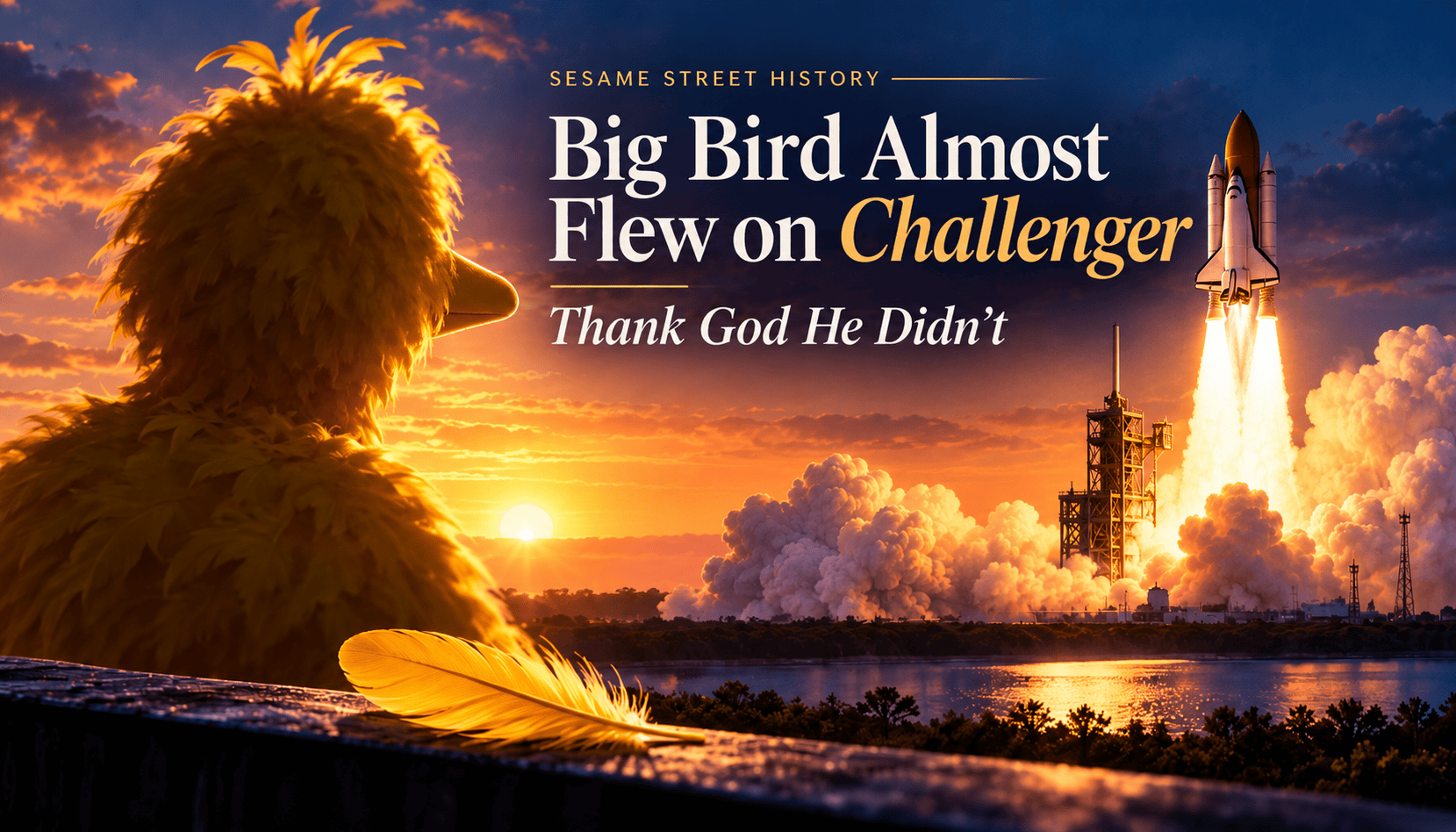
It sounds like one of those stories that has been exaggerated by the internet: Big Bird was nearly sent into space aboard the Space Shuttle Challenger.
Except this one actually has some truth behind it.
Caroll Spinney, the legendary performer who brought Big Bird to life on Sesame Street, revealed years later that NASA approached him about the possibility of taking Big Bird into orbit. The idea was simple: if one of the most beloved characters on children’s television went into space, millions of kids would suddenly become interested in NASA.
And honestly, it probably would have worked.
But knowing what eventually happened to Challenger makes the story incredibly haunting.
NASA Wanted Big Bird in Space
During the early 1980s, NASA was looking for ways to make the Space Shuttle program more accessible to ordinary Americans.
The agency created programs that could potentially send people other than career astronauts into orbit, including teachers, journalists and other civilians who could communicate the experience of spaceflight to the public.
At some point, NASA also began talking with Sesame Street about Big Bird.
Spinney later remembered receiving a message from NASA asking whether he would be willing to orbit Earth while performing as Big Bird. The goal, according to Spinney, was to get children more excited about the American space program.
Imagine that television event in 1986.
Big Bird floating around inside a Space Shuttle.
Big Bird looking down at Earth.
Big Bird explaining weightlessness to millions of kids watching from their classrooms.
It would have been one of the biggest moments in the history of Sesame Street.
There Was Just One Problem: Big Bird Was Huge
Big Bird isn’t exactly carry-on luggage.
The character stands more than eight feet tall, and performing him required Spinney to operate from inside the enormous feathered costume.
According to Spinney, NASA eventually determined there simply wasn’t enough room aboard the shuttle for Big Bird and everything required to perform the character.
The idea was dropped.
NASA later confirmed that there had indeed been early discussions with Sesame Street about participating in a Challenger flight. However, NASA also clarified that the proposal was never formally approved, an important distinction from some versions of the story claiming Spinney was already officially assigned to the mission.
And that decision may have saved Caroll Spinney’s life.
Then Came Challenger
On January 28, 1986, Space Shuttle Challenger launched from Kennedy Space Center on mission STS-51L.
Instead of Big Bird, one of the civilians aboard was New Hampshire teacher Christa McAuliffe, who had been selected through NASA’s Teacher in Space Project.
McAuliffe planned to teach lessons from orbit, giving students across America a direct connection to space exploration.
Millions watched the launch.
Just 73 seconds after liftoff, Challenger broke apart.
All seven crew members were lost: Francis R. Scobee, Michael J. Smith, Ronald E. McNair, Ellison S. Onizuka, Judith A. Resnik, Gregory B. Jarvis and Christa McAuliffe.
The Challenger disaster became one of the defining moments of the 1980s, especially for children who watched the launch live in their classrooms.
And Caroll Spinney was watching too.
Spinney Watched the Disaster Happen
Spinney later recalled that Sesame Street was filming on the day of the launch.
Production stopped so everyone could watch Challenger take off.
They saw the shuttle rise into the sky.
Then they watched it break apart.
Spinney remembered the people around him standing there crying.
For him, the tragedy must have carried an additional realization.
That could have been him.
And depending on how far NASA’s Big Bird concept ultimately would have gone, one of television’s most beloved children’s characters could have been associated forever with one of America’s greatest tragedies.
Was Big Bird Actually Supposed to Be on STS-51L?
This is where the story needs a little clarification.
You’ll often see the claim online that Big Bird was originally scheduled to fly on Challenger and Christa McAuliffe replaced him.
Spinney himself told versions of the story that made the connection sound very direct.
The surviving NASA documentation is more cautious.
NASA confirmed that discussions took place with Sesame Street about possible participation aboard a Challenger flight, but said the Big Bird plan was never officially approved.
So we shouldn’t picture Big Bird’s name being erased from an official STS-51L crew manifest and replaced with McAuliffe’s.
But the larger story is real.
NASA seriously explored the possibility of sending Big Bird into space. Caroll Spinney was interested. The idea involved Challenger. And ultimately it didn’t happen.
Considering what came next, that was incredibly fortunate.
Imagine What It Would Have Done to a Generation of Kids
The Challenger disaster was already devastating for children.
Christa McAuliffe was a teacher. Schools across North America had gathered students around televisions specifically to watch her historic journey.
Now imagine if millions of young children had tuned in because Big Bird was aboard.
Big Bird wasn’t just another television character.
For generations of kids, he represented childhood itself: innocent, curious, gentle and always trying to understand a world that sometimes didn’t make sense.
Children had already watched Big Bird struggle to understand death after Mr. Hooper died.
Imagine those same children trying to understand that Big Bird himself had been aboard Challenger.
It is difficult to even contemplate.
Thank God Big Bird Stayed on Sesame Street
There are countless strange pieces of Muppet and Sesame Street history.
This may be one of the strangest.
Somewhere in the early planning stages of the Space Shuttle era existed the possibility of Caroll Spinney climbing aboard Challenger with an enormous yellow bird costume and heading into orbit.
It would have been spectacular.
It could have inspired millions of children.
And under different circumstances, it might have become one of the greatest moments Sesame Street ever produced.
But history went another way.
Seven courageous people boarded Challenger on January 28, 1986, and none of them came home. Their loss should never be reduced to a piece of television trivia.
Still, knowing Big Bird was once considered for a Challenger flight adds an almost unbelievable footnote to that history.
For once, we’re incredibly thankful that Big Bird was simply too big.
Somewhere, somehow, one of the most beloved birds in television history dodged a fate nobody could have imagined.