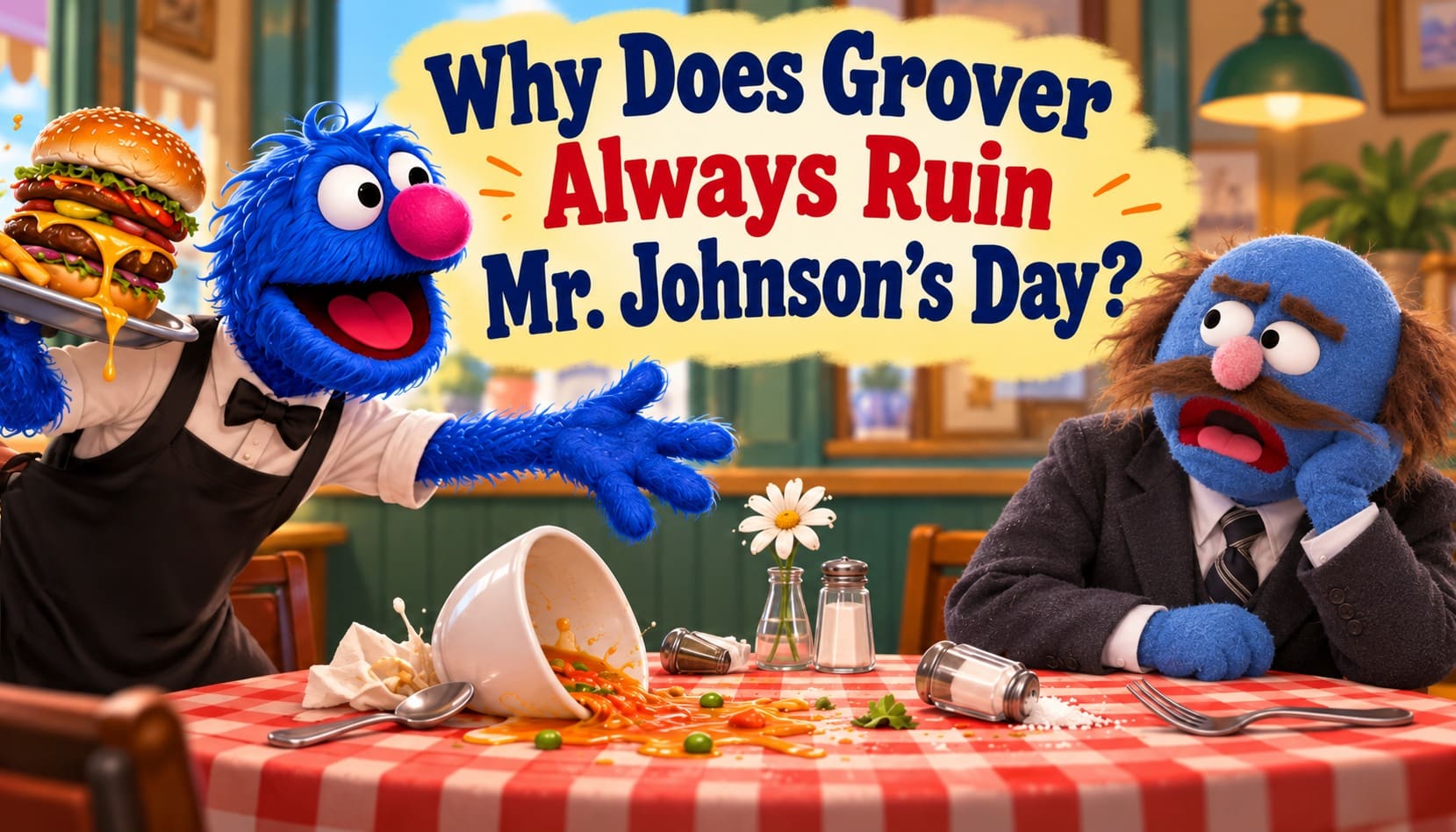

Imagine walking into a restaurant, sitting down for a peaceful lunch, and discovering that your waiter is the same furry blue monster who has ruined practically every meal you’ve ever ordered.
For most people, that would be enough to find another restaurant.
For Mr. Johnson, it’s apparently just another Tuesday.
For more than five decades, Grover and Mr. Johnson have been one of Sesame Street’s most entertaining comedy pairings. What began as a series of simple restaurant sketches in 1971 eventually became a running joke in which poor Mr. Johnson could barely leave his house without encountering Grover somewhere.
Restaurants, department stores, airports, taxis, coffee shops — it doesn’t seem to matter where Mr. Johnson goes. Somehow, Grover is always there, wearing a different uniform and enthusiastically preparing to make his day considerably worse.
But how did this wonderfully ridiculous feud begin? Why does Grover keep finding Mr. Johnson? And perhaps the biggest mystery of all: why does Mr. Johnson keep coming back?
Grab a seat, preferably somewhere Grover isn’t working, as we revisit the history of one of Sesame Street’s funniest relationships.
It All Started at Charlie’s Restaurant in 1971
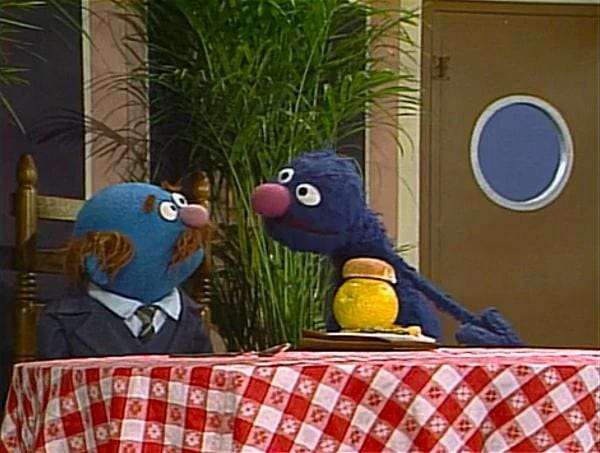
Long before Grover was showing up at every business in the neighborhood, his encounters with Mr. Johnson were largely confined to a restaurant called Charlie’s.
The restaurant sketches began in 1971, during Sesame Street’s third season. One of the earliest documented examples, Alphabet Soup, first aired on November 15, 1971, in Episode 0276.
The premise was wonderfully simple.
Mr. Johnson wanted a bowl of hot alphabet soup. But when he inspected his meal, he discovered that some letters were missing.
Naturally, Grover was determined to fix the problem.
Unfortunately, by the time Grover had returned with the missing letters, the soup was no longer hot.
Problem solved? Technically.
Customer satisfied? Not even slightly.
This early sketch established something that would become essential to the partnership: Grover genuinely wants to help, but his attempts to solve one problem have an extraordinary talent for creating another.
And Mr. Johnson, unfortunately, has to deal with the consequences.
Believe It or Not, Grover Was Sometimes the Frustrated One
Here’s an interesting piece of Sesame Street history that casual fans might not realize.
In several early restaurant sketches, Mr. Johnson wasn’t nearly as explosive as he would eventually become. Sometimes, Grover himself was the one who ended up losing his patience.
Consider the 1972 Picture Menu sketch.
Mr. Johnson orders a sandwich based on a photograph in the menu. But the sandwich Grover delivers doesn’t match the picture. The chips, pickle, and olive all need to be corrected.
After Grover finally gets everything right, Mr. Johnson announces that his lunch hour is over and leaves.
Grover is the one who throws a tantrum.
In another 1972 sketch involving bacon and eggs, Mr. Johnson takes so long deciding on his breakfast that it’s already lunchtime by the time the order is settled.
Once again, Grover ends up frustrated.
These early role reversals make the relationship even more interesting. The familiar formula of an increasingly furious Mr. Johnson facing an obliviously cheerful Grover wasn’t fully formed from the beginning.
It evolved.
And as the years passed, Mr. Johnson’s patience would be tested in ways nobody could have imagined.
The Giant Hamburger That Took Things Too Far
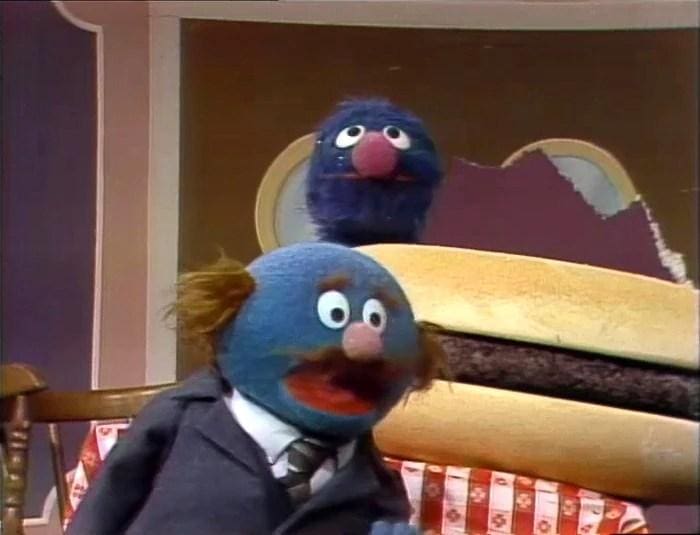
If there’s one classic Waiter Grover sketch that perfectly captures the absurdity of the series, it’s the giant hamburger.
First broadcast on December 27, 1974, the sketch begins with a perfectly reasonable request.
Mr. Johnson wants a hamburger.
Grover explains that the restaurant serves two sizes: a little hamburger and a big hamburger.
Mr. Johnson orders the little one, only to discover that it’s ridiculously tiny.
So he asks for the big hamburger instead.
That shouldn’t be complicated, right?
Wrong.
Grover seems strangely reluctant to deliver the larger option. He tries to persuade Mr. Johnson to order several smaller hamburgers instead.
Eventually, the customer insists.
And Grover returns with a hamburger so enormous that bringing it through the restaurant causes spectacular damage.
The situation has escalated from a straightforward lunch order into a full-scale architectural disaster.
And the funniest part?
Grover is still focused on providing excellent customer service.
This sketch demonstrates something that made the original Sesame Street comedy so clever.
Children could learn the difference between big and little while adults enjoyed watching a completely ordinary customer-service interaction spiral into nonsense.
Grover’s mistakes weren’t just random slapstick. They were often built around the educational concept the sketch was teaching.
Then Came the Infamous Fly in the Soup
By March 16, 1978, the duo had another memorable disaster to add to their increasingly unfortunate history.
Mr. Johnson discovers a fly in his soup.
Now, most waiters would apologize and replace the meal.
But Grover is not most waiters.
Rather than immediately fixing the issue, he inspects the situation in his own uniquely literal way, looking in all the wrong places before finally understanding the complaint.
When Grover eventually offers a replacement, the restaurant no longer has the original soup available.
Instead, Mr. Johnson is offered something called Cream of Mosquito.
Yes. Mosquito.
At this point, one has to wonder whether the restaurant has a health inspector.
The joke works because Grover remains remarkably sincere throughout the entire ordeal. He doesn’t appear to understand how completely absurd his solution is.
Meanwhile, Mr. Johnson has reached a level of frustration that almost every adult watching can understand.
Eventually, Grover Started Following Mr. Johnson Everywhere
At some point, Sesame Street’s writers realized that the Grover–Mr. Johnson dynamic was too good to leave inside Charlie’s Restaurant.
The natural next step?
Make it impossible for Mr. Johnson to escape.
And that’s when the recurring gag became even funnier.
Instead of simply returning to the same restaurant, Mr. Johnson began encountering Grover in entirely different jobs and locations.
Imagine the horror of discovering that the waiter who ruined your lunch is also the person delivering your telegram, selling you a product, or handling your next shopping trip.
1983: Grover the Telegram Messenger
In a sketch first broadcast on May 11, 1983, Grover visits Mr. Johnson’s home to deliver singing telegrams.
Unfortunately, he keeps delivering messages intended for other people.
When he finally gets the correct message, there’s still one crucial detail he can’t remember.
This sketch also carries an interesting piece of Muppet history: it’s the first documented time the customer was referred to as Mr. Johnson by name.
Before then, the character had often been identified in production materials simply as the customer or by his puppet designation, Fat Blue.
In other words, it took more than a decade of aggravation for the poor guy to get a proper name.
1989: The Fast Food Disaster at O’Brien’s
On March 28, 1989, Grover appeared as an employee at O’Brien’s Fast Food.
Mr. Johnson probably figured that fast food would mean a quick and painless meal.
Unfortunately, this particular restaurant took the word fast a little too literally.
Food came racing across the counter on trays, and customers had to catch it before it went flying onto the floor.
Mr. Johnson understandably wondered whether the establishment offered anything slower.
It did.
But the slow-food service involved a turtle.
Somehow, Mr. Johnson had discovered a restaurant where food was either dangerously fast or painfully slow.
There was no middle ground.
1995: Even a Picture Frame Wasn’t Safe
In November 1995, Mr. Johnson entered a frame shop with a painting he wanted framed.
And who was working there?
Grover, of course.
The furry blue employee initially mistook the woman in the painting for his own great-great-grandmother.
Mr. Johnson had to explain that it was actually a portrait of his wife.
Grover then experimented with different frame shapes before finally settling on a square frame.
Unfortunately, the painting itself didn’t survive his efforts.
Apparently, even something as harmless as getting a picture framed could become a personal catastrophe for Mr. Johnson.
1998–1999: Grover Takes His Talents to Fast Food and the Park
In the 1998 Chicken Castle sketch, Grover serves Mr. Johnson an empty fried-chicken bucket.
When Mr. Johnson demands a full bucket, Grover solves the problem by squeezing himself inside.
Technically, the bucket is now full.
Of Grover.
Then, in an April 9, 1999 sketch, Mr. Johnson tries to purchase a hot dog from Grover’s cart in the park.
Unfortunately, Grover is out of hot dogs.
He leaves Mr. Johnson watching the cart while he goes to fetch more, only to return and behave like a customer himself.
At this stage, Mr. Johnson wasn’t merely receiving bad service anymore.
He was being recruited into Grover’s employment problems.
The Feud Even Survived Into the Modern Sesame Street Era
Some classic television comedy pairings disappear when their original performers leave or the show changes direction.
Grover and Mr. Johnson proved much harder to separate.
In 2006, a Russian-themed restaurant sketch saw Grover serving Mr. Johnson with the assistance of musicians.
Grover eventually located a bowl of borscht, but serving it required an elaborate dance that ended with the soup landing on the customer.
Then, in 2012, the pair reunited at a coffee shop called The Coffee Plant.
This time, Grover took the establishment’s promise of fresh coffee to ridiculous extremes.
Rather than simply pouring a cup, he picked coffee beans directly from a plant, prepared them from scratch, and even brought in a cow when Mr. Johnson requested milk.
Naturally, the cow created an entirely new problem.
By then, it was clear that the jokes could adapt to newer settings without losing what made them funny.
The partnership has continued into more recent episodes as well. In a 2023 storyline, Grover was still serving Mr. Johnson at Hooper’s Store.
After all those decades, Mr. Johnson still couldn’t get a break.
The Puppeteers Who Made the Comedy Work
While the situations were ridiculous, much of the magic came from the performers bringing the characters to life.
Grover’s original signature performer was Frank Oz, whose work helped establish the monster’s extraordinary mixture of innocence, enthusiasm, and comic timing.
Mr. Johnson was primarily performed for decades by Jerry Nelson, who gave the character his increasingly memorable personality.
Nelson’s delivery was essential to the comedy.
A confused stare, a slow realization, or an increasingly irritated outburst could turn a simple disagreement about lunch into a miniature comedy masterpiece.
And Oz’s Grover was the perfect opposite.
Where Mr. Johnson wanted simplicity, Grover offered complications.
Where Mr. Johnson wanted efficiency, Grover offered enthusiasm.
And where Mr. Johnson wanted to leave, Grover inevitably found another reason to keep him there.
In later years, Eric Jacobson took on Grover, while Matt Vogel became a principal performer of Mr. Johnson.
The continuing success of the sketches demonstrates how strong the original comedy dynamic really was.
The performers could change, but the underlying joke remained immediately recognizable.
Why Does Grover Keep Ruining Mr. Johnson’s Day?
Here’s the funny thing about their relationship.
Grover doesn’t actually need to dislike Mr. Johnson for the comedy to work.
In fact, the opposite is true.
Grover is frequently delighted to see his familiar customer. He wants to be helpful. He wants to do his job properly. And he seems genuinely convinced that his efforts will eventually succeed.
That’s what makes the situation so entertaining.
Mr. Johnson sees a recurring nightmare.
Grover sees another wonderful opportunity to help someone.
And those two completely different perspectives collide every single time.
There’s also something wonderfully universal about the joke.
Everyone has encountered a customer-service situation where a simple request becomes absurdly complicated.
The restaurant gets the order wrong. The salesperson misunderstands what you need. Someone insists they’re helping while somehow making everything worse.
Grover is a wildly exaggerated version of that experience.
And Mr. Johnson reacts the way many of us probably wish we could.
Why Doesn’t Mr. Johnson Just Avoid Grover?
This might be the biggest unanswered question in Sesame Street history.
After being served impossibly large hamburgers, suspicious soup, disastrous coffee, and countless other unfortunate experiences, why does Mr. Johnson keep trusting Grover?
The obvious answer is that the writers have an excellent running joke to maintain.
But there’s another way to look at it.
Mr. Johnson isn’t necessarily seeking Grover out. The joke increasingly became that Grover was practically unavoidable.
Mr. Johnson might change restaurants, visit a new business, or simply enjoy a day in the park.
And there would be Grover.
New uniform. New job. Same problem.
The more desperate Mr. Johnson became to enjoy a normal day, the funnier it was when Grover appeared.
It’s almost as if Sesame Street invented the world’s most persistent customer-service nightmare.
And somehow made the nightmare completely adorable.
Why These Sketches Still Work More Than 50 Years Later
What makes the Grover and Mr. Johnson sketches so enduring isn’t simply the fact that Grover makes mistakes.
It’s the relationship between the two characters.
Grover is eternally optimistic. Mr. Johnson is increasingly pessimistic.
Grover approaches everything with boundless enthusiasm. Mr. Johnson approaches every interaction with understandable dread.
Grover believes things will work out.
Mr. Johnson has decades of evidence suggesting otherwise.
Yet together, they create a comedy pairing that works for children and adults alike.
For younger viewers, the sketches introduce concepts such as sizes, letters, quantities, opposites, and following instructions.
For older viewers, they’re a hilarious reminder that sometimes the most frustrating part of everyday life is dealing with someone who is absolutely determined to help.
If you enjoy the history of Mr. Johnson himself, check out our earlier feature, The Curious Case of Mr. Johnson: A Look Back at the Muppet Who Could Never Catch a Break.
And if you’ve ever suspected that Grover might not be quite as innocent as he seems, you might also enjoy The Dark Side of Grover: An Exploration of the Mischievous Muppet.
Frequently Asked Questions
When did Grover and Mr. Johnson first appear together?
Their recurring restaurant-sketch partnership dates to 1971. One of the earliest documented examples is Alphabet Soup, first broadcast November 15, 1971, in Sesame Street Episode 0276.
What is the name of Grover’s restaurant?
Grover’s most famous workplace is Charlie’s Restaurant, although he has worked in numerous other restaurants and businesses throughout Sesame Street’s history.
Who originally performed Grover and Mr. Johnson?
Frank Oz established the classic Grover performance, while Jerry Nelson was Mr. Johnson’s longtime performer. Eric Jacobson and Matt Vogel have carried on the characters in later productions.
Does Grover intentionally annoy Mr. Johnson?
The sketches generally portray Grover as enthusiastic and well-meaning rather than deliberately malicious. His inability to recognize the consequences of his actions is a major part of the humor.
Are Grover and Mr. Johnson still on Sesame Street?
Yes. The duo continued appearing long after their original 1970s sketches, including more recent scenes set at Hooper’s Store.
The Greatest Feud That Isn’t Really a Feud
More than half a century after their first restaurant encounters, Grover and Mr. Johnson remain one of Sesame Street’s most memorable comedy duos.
Not because they’re enemies.
Not because they constantly argue.
But because one of them is absolutely convinced he’s being helpful, while the other desperately wishes he would stop.
And perhaps that’s the real secret behind their enduring popularity.
Mr. Johnson doesn’t need a villain in his life.
He has Grover.
And Grover has a new job.
Which can only mean one thing.
Somewhere on Sesame Street, Mr. Johnson is about to have another very, very long day.
Now it’s your turn, Muppet fans!
What’s your favourite Grover and Mr. Johnson sketch? The giant hamburger? The fly in the soup? The coffee shop? Or one of Grover’s many disastrous jobs?
Tell us in the comments — and be honest: how many minutes would YOU last with Grover as your waiter?