
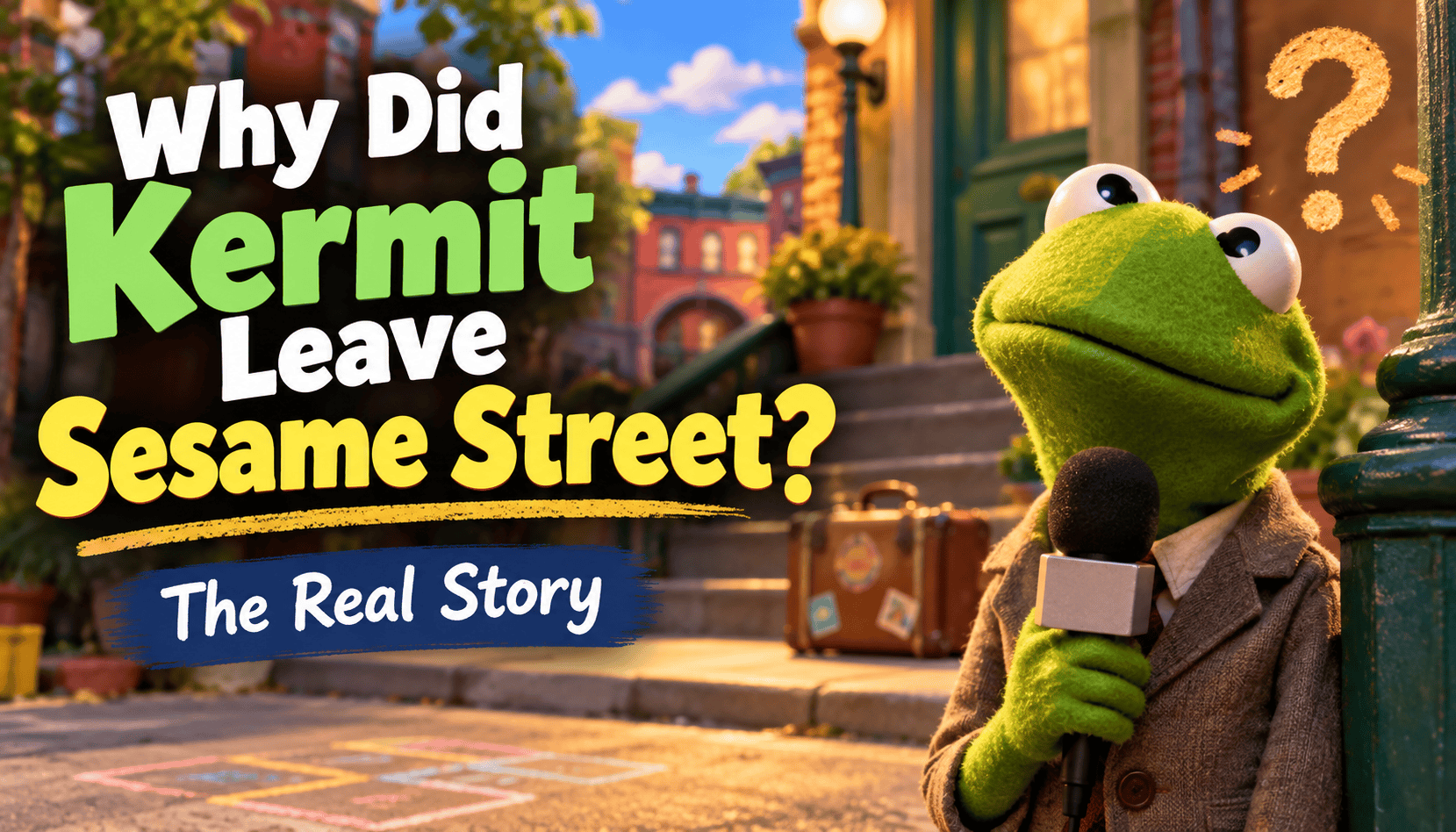

For generations of Sesame Street fans, Kermit the Frog seemed like just as much a part of the neighborhood as Big Bird, Oscar, Bert and Ernie.
He taught lessons. He interviewed fairy-tale characters as a frustrated television reporter. He sang “Bein’ Green.” He tried to explain simple concepts while other Muppets made his job nearly impossible.
Then, little by little, Kermit seemed to disappear.
So why did Kermit leave Sesame Street?
The answer is a little more complicated than Kermit simply quitting the show. There was no dramatic farewell episode, no story where Kermit packed his bags and moved away, and no single moment when Sesame Street announced that he was gone.
Instead, Kermit gradually became a rare guest on the program as the ownership of the Muppets and the Sesame Street characters went in different directions.
And the story actually begins long before Sesame Street existed.
Kermit Wasn’t Originally a Sesame Street Character
This is one of the biggest reasons for the confusion.
Kermit may be closely associated with Sesame Street, but he wasn’t created for the show.
Jim Henson created the original Kermit in 1955 for his Washington, D.C. television series Sam and Friends. That means Kermit had already been around for approximately 14 years by the time Sesame Street premiered in 1969.
The earliest Kermit didn’t even look quite like the frog audiences know today. The original puppet was made partly from fabric taken from an old coat belonging to Henson’s mother, with ping-pong-ball eyes. Kermit initially had a more lizard-like appearance before gradually developing into the familiar frog.
When Sesame Street was being developed, Jim Henson brought his Muppets into the new educational television experiment.
Kermit came along with him.
Kermit Became One of Sesame Street’s Biggest Stars
Once Sesame Street began, Kermit quickly became one of its most recognizable characters.
Unlike many characters who primarily lived on Sesame Street itself, Kermit could appear almost anywhere.
He gave educational lectures about letters, numbers, shapes and opposites. He interacted with children. He sang songs. And, of course, he became the increasingly exasperated reporter for Sesame Street News.
Wearing his reporter’s trench coat and holding a microphone, Kermit attempted to cover stories involving characters from fairy tales and nursery rhymes.
Naturally, almost nothing ever went according to plan.
Rapunzel, Cinderella, Humpty Dumpty, the Three Little Pigs and countless others turned what should have been straightforward news reports into complete chaos.
Those sketches became such a major part of Kermit’s identity that Sesame Street continues to celebrate them decades later. Official Sesame Street channels still release compilations of Kermit’s classic News Flash segments for modern audiences.
And then there was the song that became inseparable from the character.
“Bein’ Green” Helped Define Kermit
Written by Joe Raposo, “Bein’ Green” debuted as a Sesame Street song and became one of Kermit’s most famous performances.
What began as a children’s song about a frog wishing he were a more exciting color developed into something much bigger—a song about accepting who you are.
Sesame Workshop still identifies it as Kermit’s signature song, and over the years it has been covered by performers including Frank Sinatra, Diana Ross and Van Morrison.
For viewers who grew up during the 1970s and 1980s, it would have been easy to assume Kermit belonged to Sesame Street.
But legally, things were different.
So Who Actually Owned Kermit the Frog?
Kermit remained part of Jim Henson’s larger Muppet family rather than becoming one of the characters owned exclusively by the organization behind Sesame Street.
That distinction wasn’t very noticeable to viewers while Jim Henson and his company remained heavily involved with both worlds.
Kermit could appear alongside Big Bird and Grover on Sesame Street, then turn around and host The Muppet Show alongside Miss Piggy, Fozzie Bear and Gonzo.
To audiences, it all looked like one giant Muppet universe.
Behind the scenes, however, those groups of characters eventually became separate properties.
And that difference became extremely important.
Did Kermit Leave Sesame Street After Jim Henson Died?
Jim Henson died unexpectedly in May 1990.
Kermit did not disappear from Sesame Street immediately after Henson’s death.
Steve Whitmire eventually took over performing Kermit, and the frog continued making appearances in Muppet productions and occasionally on Sesame Street.
However, new Sesame Street appearances gradually became less common.
One particularly memorable later appearance came during the show’s 2001 hurricane storyline, when Kermit returned to his familiar role as a reporter and delivered a Sesame Street News update alongside Al Roker.
That episode became Kermit’s final new appearance on the regular program for several years.
Then came the event that created the clearest separation between Kermit and his old Sesame Street neighbors.
Disney Bought Kermit in 2004
In February 2004, The Walt Disney Company announced an agreement to acquire the Muppets from The Jim Henson Company.
The deal specifically included characters such as:
Kermit the Frog, Miss Piggy, Fozzie Bear, Gonzo and Animal.
But there was one major exception.
The deal did not include the Sesame Street characters.
Disney’s own announcement specifically stated that characters such as Big Bird and Elmo were separately owned by Sesame Workshop.
Suddenly, the distinction that had been largely invisible to generations of viewers became much more obvious.
Kermit belonged to Disney.
Big Bird, Elmo, Oscar, Cookie Monster, Bert, Ernie, Grover and the other Sesame characters belonged to Sesame Workshop.
They were now characters controlled by two separate organizations.
Did Disney Force Kermit Off Sesame Street?
There doesn’t appear to be evidence of some dramatic order from Disney demanding that Kermit be removed from Sesame Street.
That’s an important distinction.
Kermit’s appearances had already become much less frequent before Disney purchased the Muppets in 2004. His final new appearance on the regular show before a long absence came in 2001.
So saying “Disney bought Kermit and immediately kicked him off Sesame Street” would oversimplify what happened.
What the Disney purchase did do was make the separation permanent and obvious.
Any new appearance featuring Kermit on Sesame Street now involved a Disney-owned Muppet appearing in a Sesame Workshop production.
That made Kermit fundamentally different from characters such as Grover or Cookie Monster, even though longtime viewers understandably continued to think of him as one of the Sesame gang.
But Kermit Has Returned to Sesame Street
Here’s another reason saying Kermit “left” isn’t completely accurate:
He has come back.
In 2009, Kermit made a brief surprise appearance during an Elmo’s World segment about frogs in Sesame Street’s 40th season.
Then came a much bigger reunion.
For Sesame Street’s 50th Anniversary Celebration in 2019, Kermit returned again.
Sesame Workshop itself promoted Kermit as one of the special’s rarely seen returning characters. During the celebration, he appeared alongside the Sesame cast and performed “Bein’ Green” with Elvis Costello.
By that time, Kermit was being performed by Matt Vogel.
Interestingly, Vogel has worked on both sides of the divide. Sesame Workshop has publicly identified him both as a performer of characters including Big Bird and Count von Count and as the performer of Kermit for the Disney Muppets.
So Kermit can still visit Sesame Street.
He’s just no longer one of its regular residents.
Can Sesame Street Still Show Old Kermit Sketches?
Yes—and that’s another reason Kermit never completely disappeared from the Sesame world.
Classic Kermit material continues to be associated with Sesame Street. Old songs and sketches remain part of the program’s history, and Sesame Workshop continues celebrating material such as “Bein’ Green.”
Classic News Flash segments have also continued resurfacing through official Sesame Street video channels.
That means a child discovering Sesame Street today can still encounter the same increasingly frustrated frog that their parents—or even grandparents—watched decades earlier.
Why Do People Remember Kermit as a Sesame Street Character?
Because for all practical purposes, he was one to the audience.
Kermit appeared on the program from its earliest years.
He interacted with its characters.
He appeared in educational segments.
Some of his most famous material was created specifically for Sesame Street.
And Jim Henson himself was so deeply connected with both Kermit and the early identity of the program that separating the two can feel strange.
But Kermit always had another life.
He existed before Sesame Street.
He became the host of The Muppet Show.
He starred in Muppet movies.
And eventually, the corporate ownership of the two Muppet families separated.
The Smithsonian’s National Museum of American History sums up Kermit’s unusual career rather neatly: he debuted on Sam and Friends in 1955, appeared in promotional material for Sesame Street in 1969, and then continued appearing both on Sesame Street and in other Henson productions.
Few television characters have ever managed to belong so completely to several different eras and franchises at once.
So, Why Did Kermit Leave Sesame Street?
The simplest answer is:
Kermit didn’t really leave Sesame Street in the traditional sense.
There was no goodbye episode and no single creative decision that removed him.
Instead, his appearances gradually became less frequent, while the business relationship surrounding the characters changed.
Kermit had always been part of Jim Henson’s broader Muppet family rather than a character created exclusively for Sesame Street. When Disney purchased the Muppets in 2004, Kermit became a Disney-owned character while the Sesame Street Muppets remained with Sesame Workshop.
That ownership split helps explain why the frog who once seemed to be everywhere on Sesame Street became an occasional special guest instead.
But more than half a century after he first reported from the neighborhood, Kermit’s Sesame legacy hasn’t gone anywhere.
He’s still the frog who tried to teach us.
He’s still the reporter who could never get through a news story without something going horribly wrong.
And whenever that familiar green face turns up on Sesame Street again, it feels less like a guest appearance and more like an old neighbor coming home.